


From Concept to Installation: What It's Really Like to Commission Custom Metal Art
You’ve found the perfect moment in a space to add some interest. Maybe it’s a lobby that needs an anchor — a sculpture that commands the room before a single word is spoken. Maybe it’s a corridor that calls for a topographic map that tells the story of the land the property sits on. Maybe it’s an open floor plan that needs a metal screen or divider that defines zones without closing them off. Or maybe it’s simply a wall that deserves something more than paint. You can almost picture the piece. But commissioning custom metal art for the first time — or even the fifth time — can feel like stepping into the unknown.
What does the process actually look like? How long does it take? How much input do you have? And what happens when the vision in your head meets the reality of fabrication?
As designers ourselves, we’ve walked alongside designers and curators through every stage of this process — from the first phone call to the moment a finished piece is delivered and ready for your team to bring to life in the space. Here’s an honest look at what commissioning custom metal art is really like — and why so many designers come back to collaborate with us again. From concept to installation, we partner with you through the entire process for the best results.
It Starts with a Conversation, Not a Catalog
The first thing most people are surprised by is how the process begins. There’s no catalog to flip through, no standard SKU to select. When you reach out to commission a custom piece, the starting point is always a conversation.
Because we’re designers too, we come to that first conversation as a creative partner, not an order-taker. We want to understand the space — the architecture, the light, the materials already in play. We want to know about the brand, the story the property is trying to tell, and the guests it wants to attract. And we want to understand you — your instincts, your references, what you’re drawn to and what you’re deliberately avoiding.
This discovery phase isn’t a formality. It’s the foundation of everything that follows. Designer to designer, the more openly we can explore the intent behind the project, the more precisely we can develop concepts that feel like they were made for that exact space — because they were. Your vision stays at the center of every decision we make from here.


Concept Development: Where Vision Becomes Form
Once we have a clear picture of the project, our design team gets to work on concepts. This stage is genuinely collaborative — designer to designer. We’re not disappearing into the studio for weeks only to emerge with a single take-it-or-leave-it proposal. We share early sketches, explore multiple directions, and invite your creative input at every turn. This is your vision; our role is to help you realize it in metal.
For hospitality projects, this phase often involves exploring both the form the work will take and the role it will play in the space. A freestanding sculpture brings presence and dimension to an entry or courtyard in a way that nothing else can. A topographic map rendered in layered metal connects guests to the geography and character of a place before they ever step outside. A wall art piece can define a brand or set a mood across an entire floor. And a metal screen or divider — like the piece at the heart of this featured project — does something uniquely powerful: it shapes space, controls sightlines, and filters light while functioning as a work of art in its own right.
Metal is an extraordinarily versatile medium — it can be plasma-cut with hair-thin precision, hand-hammered into organic texture, fabricated into dimensional relief, or layered into topographic depth. It can be finished with patinas that range from raw industrial to warm bronze to mirror polish. Part of the concept phase is a creative dialogue about which form, scale, and expression of metal best serves your vision and the specific demands of the space.
Scale studies and material samples come early. There’s no substitute for seeing a finish in person, under real light, against real surfaces. We encourage designers to bring samples into the space before anything is finalized — your eye in that room is irreplaceable.

“From concept to installation, this divider wall was a true collaboration. What began as a vision of spaced vertical bars evolved into a refined system with an adjustable leveling mechanism, allowing each element to align perfectly with the ceiling for a seamless finish. Through clear communication and transparency during the technical phase, we were able to anticipate challenges, adapt quickly, and deliver a solution that not only met the design intent but elevated it—proving that the best results come from working together with precision and openness.”
Brianna Parmley
Creative Designer & Customer Lead
Alabama Metal Art

Approvals, Engineering, and the Details That Matter
Once a concept direction is approved, the work shifts into technical development. This is the phase that separates a beautiful idea from a piece that can actually be built, packaged, and delivered ready for your installation team — and it’s where experience matters enormously.
Custom metal art for commercial hospitality environments comes with real engineering requirements that vary significantly by form. Large-scale wall art and sculptural pieces need to account for wall load, seismic considerations, and ceiling height. Metal screens and dividers require structural engineering for freestanding stability or proper anchoring to floors and ceilings. Topographic map installations — often built up in multiple-dimensional layers — need precise hardware to support depth and weight across a broad surface. Outdoor sculptures and screens require finish specifications that can withstand UV exposure, humidity, and temperature fluctuation.
We handle all this in-house, and we communicate clearly with you and your project team throughout. Shop drawings are submitted for your approval before a single piece of metal is cut. Nothing moves forward until everyone — designer, curator, ownership, and our fabrication team — is aligned in every detail.
This is also where timelines get locked in. Depending on the complexity and scale of the piece, fabrication typically runs anywhere from six to sixteen weeks. We’ll give you a realistic schedule upfront and flag any dependencies early so there are no surprises as you coordinate with your broader project team.

Fabrication: Craft at Scale
There’s something genuinely moving about watching a concept become a physical object. When fabrication begins, raw metal — steel, aluminum, corten — gets cut, formed, welded, ground, and finished by skilled hands. Even when we’re using CNC plasma cutters for precision work, the process involves an enormous amount of human craft.
The fabrication approach shifts depending on the form. A sculpture is built from the inside out — an armature, then structure, then surface. A topographic map is constructed layer by layer, each contour carefully cut and assembled to create depth and dimension that photographs can’t fully capture. Wall art pieces may involve cutting, texturing, and finishing individual elements before assembly. And a metal screen or divider like the one featured in this project requires both artistry and precision engineering — every opening, every joint, every edge has to be exactly right because the piece lives in three dimensions and gets experienced up close from every angle.
For larger commissions, we often build full or partial mock-ups before completing production — especially for repeating elements or dimensional work where seeing a section at full scale reveals things that don’t show up on paper. Designers who visit the studio during fabrication almost always say it’s one of the highlights of the project. Seeing the work in progress builds a shared ownership of the outcome that carries all the way to the finished piece.
Delivery: Handing the Finished Work Over to You
After months of collaboration, engineering, and fabrication, the piece is complete — and this is where our work transitions into yours. We take delivery seriously, because a beautifully crafted piece deserves to arrive in perfect condition and be as easy as possible for your installation team to handle.

Every piece — whether it’s a freestanding sculpture, a multi-layer topographic map, a wall art commission, or a full metal screen and divider system — is carefully inspected, documented, and packaged for the realities of commercial freight. For each project, we work with you and your team ahead of time to provide detailed installation drawings, hardware specifications, mounting or anchoring templates, and care instructions — everything your crew needs to bring the piece into the space exactly as designed.
For phased or multi-panel works, we coordinate delivery sequencing with your schedule so pieces arrive in the right order at the right time. We’re available throughout the installation process to answer questions and troubleshoot alongside your team by phone, video call, or on-site documentation — whatever keeps things moving smoothly.
And then the scaffolding comes down, the dust settles, and the vision you’ve been carrying for months is finally standing in the room.

FEATURED PROJECT: CUSTOM METAL BAR POST DIVIDER WALL
PROPERTY: Hyatt Regency Hotel
LOCATION: St. Louis, Missouri
DESIGNER OR CURATOR: KMC&A Design
PROJECT DESCRIPTION: Custom metal bar poles installed with exact spacing to provide a divider wall used in the lobby and bar seating area. Custom designed with the ability to adjust to accommodate any slight differences in ceiling height.
Ready to Start the Conversation?
Every great piece starts the same way — with a space, a vision, and a conversation between designers. Whether you have a fully developed concept or just a feeling you’re trying to capture, we’d love to hear about your next project and explore what we can create together. Let us partner with you from concept to installation.
Latest Blog Posts

The Art of Scale: Custom Metal Art Seamlessly Mass Produced
How Creative Edge Seamlessly Mass Produces Custom Metal Art for Hospitality Spaces When…

Built to Last: How Metal Art Withstands the Test of Time in Commercial Spaces
In the world of commercial design, form always meets function—and metal art is…
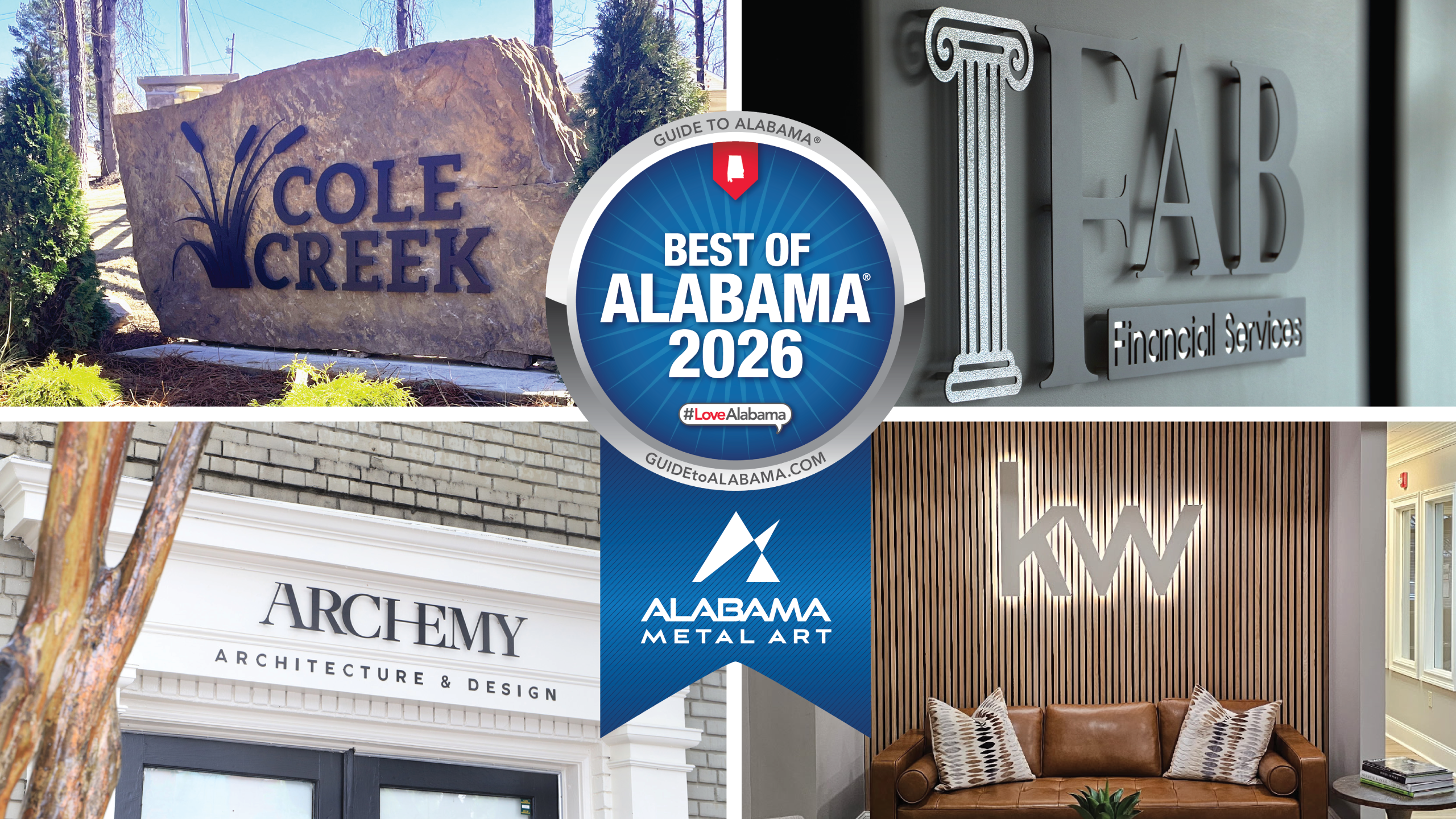
Alabama Metal Art Named Best of Alabama for Printing and Signage Services
We are proud to share some exciting news: Alabama Metal Art has been…